The hardest thing is to write the first line. At least that's what my friend Andy Golding told me. Until you write it, you're just someone thinking about writing a book. Once you do, you're someone writing one.
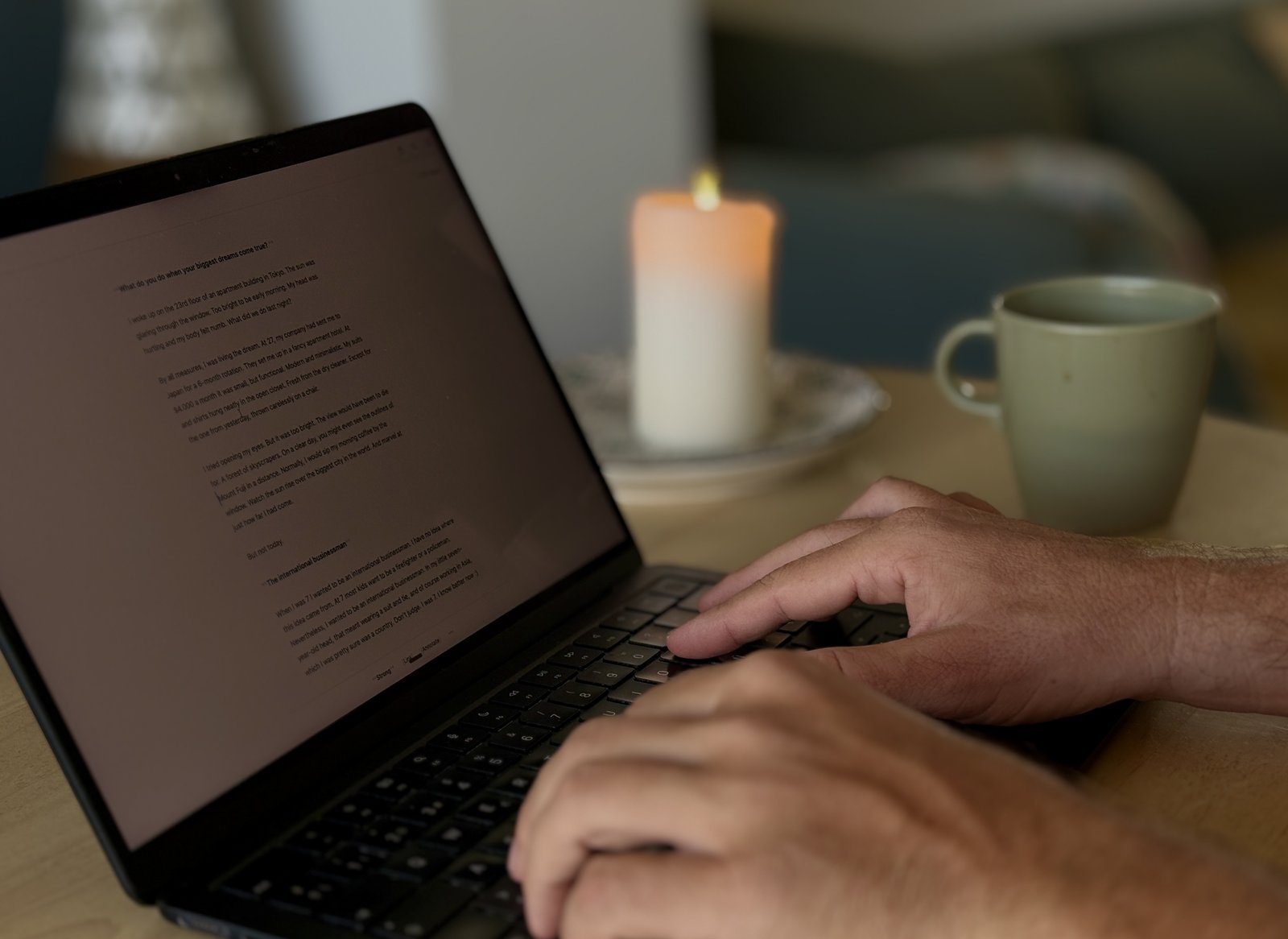
So yesterday I sat down with a clear desk, a clear mind, and a warm cup of coffee, and wrote the first line of my book, The Art of Reinvention. Then I kept going, all the way to 1,700 words. I really enjoyed it, and I'm proud of myself.
This is the first part. I'll be sharing it here as I write it, so if you want to read along and follow the story, sign up at the bottom and I'll send you the next parts as they come.
Here it is.
What do you do when your biggest dreams come true?
I woke up on the 23rd floor of an apartment building in Tokyo. The sun was glaring through the window. Too bright to be early morning. My head was hurting and my body felt numb. What did we do last night?
By all measures, I was living the dream. At 27, my company had sent me to Japan for a 6-month rotation. They set me up in a fancy apartment hotel. At $4.000 a month it was small, but functional. Modern and minimalistic. My suits and shirts hung neatly in the open closet. Fresh from the dry cleaner. Except for the one from yesterday, thrown carelessly on a chair.
I tried opening my eyes. But it was too bright. The view would have been to die for. A forest of skyscrapers. On a clear day, you might even see the outlines of Mount Fuji in a distance. Normally, I would sip my morning coffee by the window. Watch the sun rise over the biggest city in the world. And marvel at just how far I had come.
But not today.
The international businessman
When I was 7 I wanted to be an international businessman. I have no idea where this idea came from. At 7 most kids want to be a firefighter or a policeman. Nevertheless, I wanted to be an international businessman. In my little seven-year-old head, that meant wearing a suit and tie, and of course working in Asia, which I was pretty sure was a country. Don't judge. I was 7. I know better now :)
Even then, I loved a big goal. So I got to work. I did well in school. I got myself a Bachelors of Information Systems, and a Masters while surfing in Australia. I turned down an offer from IBM, and landed a two-year rotational trainee program at General Electric. More specifically, GE Money Bank. Time to invest in some quality suits.
I didn't know it at the time, but this turned out to be one of the most prestigious leadership trainee programs in the world. GE had gotten these programs down to an art, and onboarded 50 graduates from across the globe every 6 months. It was rigorous training, combined with increasingly complex work assignments. We were measured on everything, with leaderboards and awards for programming, databases, project management and the overall best in class.
The trainee program was regional. Four rotations in the Nordics. But my dream was to work in Asia, so I asked my boss, who patiently explained that this is corporate, and we have to follow the rules. But I've never been great with rules, so I challenged him. "What would have to be true, for us to change the rules?" Or in other words "What do I need to do, to get to Asia?". He smiled, and thought about it for a while and said "Ken. If you make it to best in class, I'll see what I can do."
I was bummed. I was competing with the best of the best from across the globe. Best in class seemed like an impossible goal.
We would gather for Bootcamps, to make sure we all had the necessary skills to take on our upcoming assignments. The first one was 4 weeks, at a sad hotel in Danbury Connecticut, intentionally far away from anything fun. We would work 10-12 hours a day. 6 days a week. The group was friendly, but the competition was cut throat. Several dropped out the first week, realising the pressure was not for them.
Leaderboards were published weekly, leading up to the final awards ceremony. I did my best, and stayed within the top 10 in each of the categories. I rarely made top 3, and only once made the top spot, for project management. So one day while the others went out for Karaoke, I stayed behind and made a decision. I wasn't gonna make it to the top. So instead of fighting, I would just have fun, enjoy the ride, and do what I do best; Share my knowledge and help others.
Having let go of the pressure, I found more time to make friends. I supported people who were struggling. I thought an unofficial class on a Lean/Six Sigma which GE had just started implementing. I spent time with the instructors, who were experienced GE leaders, and built connections which lasted far beyond the program. I was ok with not winning. I was present and taking in the full experience.
I'd like to say I felt content as the awards were presented. But the truth is, I was sad. This was one of the first times in my life I hadn't realised my goal. My boss would be disappointed. I was disappointed.
I cheered my colleagues as the dinner went on, and probably had a few more glasses than I should. I wasn't paying much attention when we got to the final award. Best in Class. They red the justification. I barely noticed. Someone who was strong across the board. Blah blah.. Someone who had gone above and beyond teaching GE methodologies. Blah blah.. Someone who had lifted their peers.. blah blah. "The award for Best in Class 2007, goes to Ken Hellem".
I was dumbfounded. I didn't understand it at first. Everyone was looking at me. I stumbled up to the stage, and made a poor attempt at a speech. Everyone clapped and congratulated me. Even the instructors.
My boss delivered on his promise. For my third rotation he pulled some serious strings. Called in a favour, and I was sent off to Tokyo to help implement a new financing product to attract a new customer segment.
But now I'm here on the 23rd floor of a luxury apartment building. The whole world outside my window. And I can't get out of bed.
What had happened last night?
The hangover that wouldn't go away
It slowly came back to me. A package had been delivered to my cubicle yesterday morning. Inside was a small shiny white cardboard box. I knew immediately what it was. Something necessary to do business in this part of the world. I'll never know why it had taken so long to arrive, but there it was.
I opened it with care, and found a stack of pristine business cards. Ken Hellem. Project Manager. Email. Phone number. Office address. All in English.
In Japan, all business is initiated by first sharing business cards. You give and receive with both hands. Look at it with admiration and store it safely in a special case. It's a ritual that says I see and respect you.
However, most Japanese don't speak English. An English business card is considered rude or at least unrespectful. They will still go through the ritual to make sure nobody looses face. But you know.
So I flipped the card over. And on the backside was my name, title and address in Japanese Kanji. Time stopped. It was a silent moment of pride. The card was a symbol that I had realised my biggest dream. At 27, I was wearing a suit and tie. In Asia. With my own genuine Japanese business card. I was finally an international business man.
My friends did not understand the significance. "Dude It's just a business card. Look, we all have them". But I wanted to celebrate, and nobody would turn down free booze. So we had dinner, and drinks, and more drinks and sang karaoke until the early morning.
Now my suit is crumpled on the chair. And I can't get out of bed.
I thought it was a hangover. A result of a few too many drinks. But it didn't go a way. I finally made it out of bed. But I felt numb. The next day the same. And the day after. I felt empty inside. Like I had no motivation to do anything. I dragged myself to work. Went through the motions. But nothing.
The next few weeks were a blur. I had never felt like this before. I would have been scared, but for some reason I didn't even care. It was like nothing mattered.
I slowly came to the realiziation that I no longer had a goal. For 20 years I had chased my dream of becoming this international business man. The goal had propelled me forward. But now that I had achieved it, I was goalless. I had no direction or motivation to move.
I've always been goal oriented. The bigger the better. I had become successful by running very fast towards a fixed target. One win leading to the next. I had built this persona of a young ambitious professional that would stop at nothing to reach his goals. Success in itself was exciting, and I was living the dream. I was very much running on autopilot. Taking on whatever lay in front of me. Picking the biggest challenge I could find.
Until there was nothing more to aim for.
The placeholder
At 27, I had no grasp of the concept of purpose. I realise now that purpose gives you direction, and goals give you the momentum to move towards them.
Had I known then, what I know now, perhaps I could have done the work to try to identify what's important in my life. To learn who I was and what I really wanted from life.
But all I could do was reach for a bigger goal. But nothing came up. So instead I set a placeholder goal. I decided if I can't think of a real goal, at least I can set a big one. I decide I'll become the CEO of Fortune 500 company. The top guy at on of the 500 biggest companies in the world. There are 500 of those roles, so it must be possible. Right?
Back to the drawing board.. I designed a perfectly linear career path. Made detailed plans and started executing. Finished up the trainee program, and switched to consulting. Bought more expensive suits, learned how to trick executive teams into believing I had a lot more experience than I did. I chased the promotions and actually did pretty well for myself.
The energy and motivation was back, but in the back of my mind I, had this nagging feeling that something was off. Once again I was running fast, but towards what? A made up goal?
It was time for my first reinvention.
Follow the book as it gets written
I'm writing The Art of Reinvention this year and sharing it part by part. Join the list and I'll send you the next part, plus the odd story and exercise from the book. No spam, unsubscribe anytime.