Say you have two or three ideas for a new career. Maybe you found them through conversations, or through your Ikigai. They all look interesting. But which one is right? And how do you find out without quitting your job and hoping for the best?
Here is the short answer to how to try out a new career before you quit your job. Run a small, real test of the new work that fits around your current job. Give it a clear start and end, usually about a month. Take notes every day on how it feels and how people react. Then decide what to do next, based on what happened instead of what you imagined.
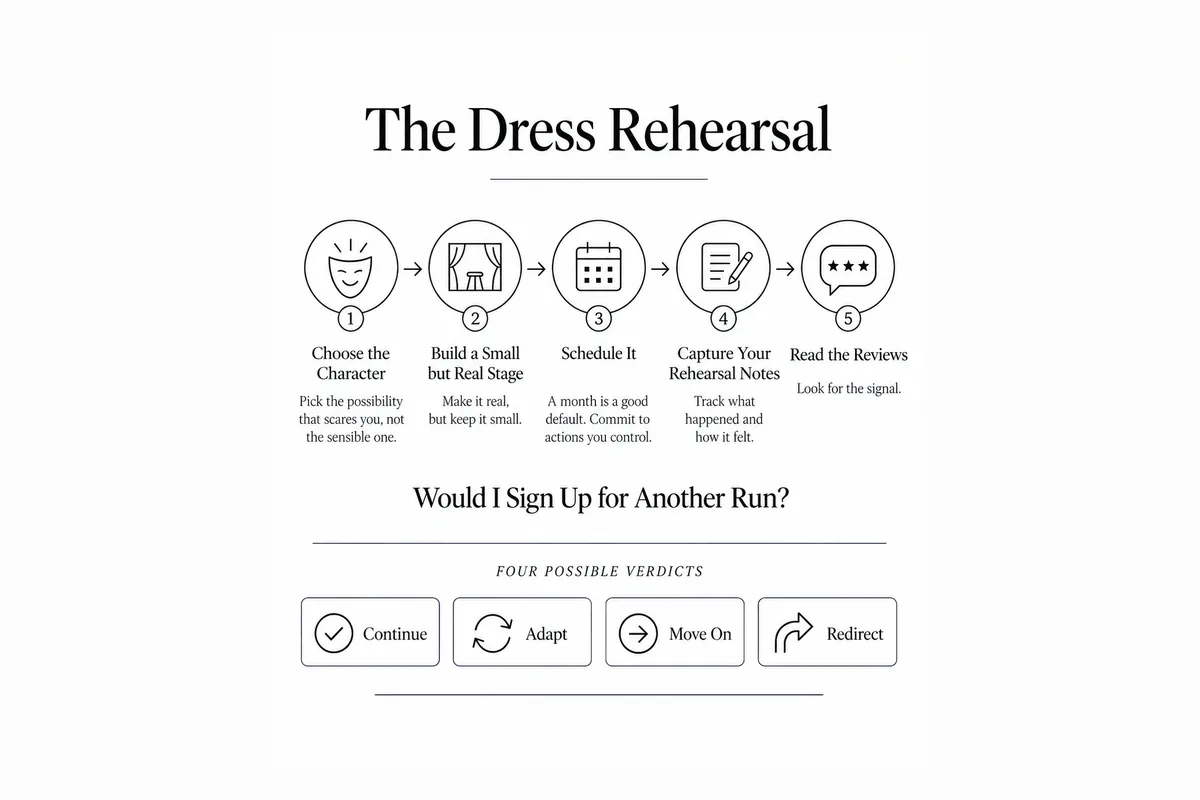
In my book I call this a Dress Rehearsal. It's a small but real performance of a possible future. It happens before you make the big change.
Why you should test a new career before you quit
A lot of people think a career change starts with a big jump. Quit, then figure it out. I understand the appeal. But it's a very expensive way to learn that you don't like the new work.
Don't quit your job to test whether you might like another one. Don't move your family across the country, invest your savings, or build a company before you know whether you even enjoy the work.
From The Art of Reinvention
A test won't prove that the new direction will work. That's fine. The point is to learn enough that your big decision is based on real experience and not only on a fantasy.
Your current job can help you here. It still pays the bills. It may give you contacts, stability, or some free evenings. So for now, you can treat it as part of the bridge to what comes next. I wrote more about this in how to reduce the risk of reinvention.
One simple rule: if your test requires you to quit first, it's too big. You've skipped the part where you get to change your mind. Make it smaller until it fits.
How big should the test be?
Small enough to fit around your job, your family, your bills and everything else you already have going on. That limit is useful. It forces you to shrink the idea into something you can actually test.
If you don't have a month of free evenings, take a smaller stage. One Saturday. Three lunch breaks. The size matters a lot less than actually doing it.
You can also test more than one idea. It's like tasting three dishes to know which one you prefer. But sometimes one is enough. If you taste the Thai food and love it, you don't need to try the rest. Go have Thai :)
Misty's Dress Rehearsal: from project manager to working artist?
The best way to explain this is with a real example. Misty is a project manager with a strong creative side. She makes jewelry and paints. She also loves finding old clothes in thrift stores. She buys a plain secondhand jacket, paints it, adds details, and resells it as a one-of-a-kind piece.
She wanted to make money from her art. But how? Sell paintings? Repurpose clothes? Build an online shop? Or maybe some parts of her creativity were better kept outside of work.
So she ran a Dress Rehearsal on evenings and weekends. Her project manager job paid the rent while she found out whether the art idea was real.
How to try out a new career before you quit your job, step by step
Here is the Dress Rehearsal as it appears in the book. Spend some time designing it before you start, so you get the most out of your evenings.
- Choose the character. Pick one possible future you are curious about. I'd suggest not picking the safest one. Start with the unexpected one, the one that scares you a little. That's where you learn the most. Check it against your values first. If the test means a month of doing the opposite of what you care about, you already know how it ends. Then write down one clear question you want to answer. "Should I become an artist?" is too big. Misty's question was: "Could I make money from my art without ruining the part I love?"
- Build a small but real stage. Two words matter here: real and smallest. Real means you do the actual work with actual people. Take on a real photo shoot. Offer something to real customers. Organize a real event. Small means it fits your current life. If you dream of a restaurant, run a supper club one Saturday a month. If you want to be a photographer, don't spend €10,000 on gear. Borrow or rent it. Also include some of the boring backstage work, like pricing, promotion and deadlines. Misty already knew she enjoys creating. What she needed to test was what happens when creating meets customers and money.
- Schedule it. Give it a clear start and end date. A month is a good starting point. It's long enough to catch the good days and the bad days, and short enough not to take over your life. Then write down the actions you will take. Choose actions you control. For example, commit to contacting twenty potential clients instead of promising yourself three paying ones. Misty's plan for thirty days: create three new paintings and share them, repurpose three secondhand clothing pieces, and offer it all for sale on Etsy.
- Take notes every day. In your journal, number the days from 1 to 30. Make columns for what you want to track: what you did, your energy from 1 to 10, your mood, and any numbers that matter for your test. Then write a few lines each day. What gave you energy? What drained you? When did you lose track of time? And how did people react? What did they comment on, ask about, or buy? Don't wait until the end of the week. Your memory will change the story.
- Read the reviews. When the month ends, go through your notes. Color-code the tracker. Look for patterns, the ups and the downs. Ask two questions: how did the world react, and did I enjoy doing it? You'll probably know after two weeks.
- Decide if you want another run. There are four useful answers. Continue: you want to explore the same role further. Adapt: part of it fits, so you change the next test. Move on: you learned enough, and this role isn't for you. Redirect: something unexpected caught your attention and points somewhere else.
You'll find this exercise, together with all 18 exercises from the book, on the book tools page.
What Misty learned from her month
On day 5, Misty spent most of Saturday painting a jacket she found at a thrift store. She lost track of time. She posted it on Instagram that evening, and three people asked if it was for sale. It sold for much more than she paid for the jacket.
On day 8, she finished a painting she really loved. She didn't feel like posting it, but she did anyway. She enjoyed the likes and comments. She didn't want to sell it.
At the end of the month the picture was clear. People liked both the paintings and the clothes. But the clothes got much more buying interest. Several pieces sold quickly, people asked when the next ones would come, and the margins were better than she expected.
She wanted to keep painting, but not as a business. Selling her paintings changed how painting felt. Repurposing clothes was different. She loved finding something unwanted, turning it into something new, and selling it to someone excited to wear it.
Her answer was Adapt. She found out she could enjoy making money from her art. Just not all of it. She could never have known that without trying.
That is the whole point. You don't need to predict your future or bet your current life on an idea. You make it small enough to try alongside the life you have, you try it, and you adjust. If the test tells you to go ahead, the next step is making the big decision itself.
Where the Dress Rehearsal fits in the book
This post is built on "The Dress Rehearsal", a chapter in Sense, the fourth step of the ARISE method in The Art of Reinvention. In the book it comes after you have found out who you are and collected a few possible futures. It's the step where you test them in the real world.
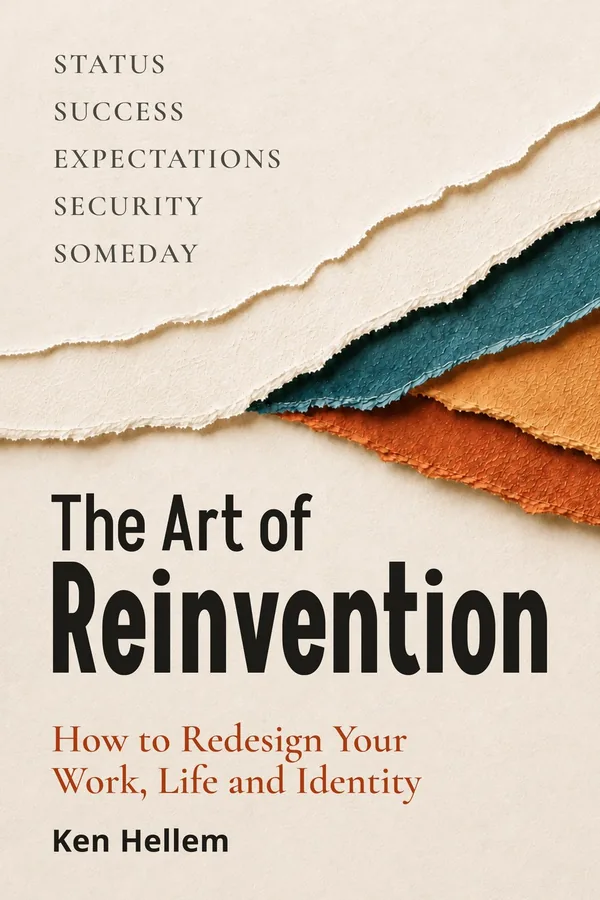
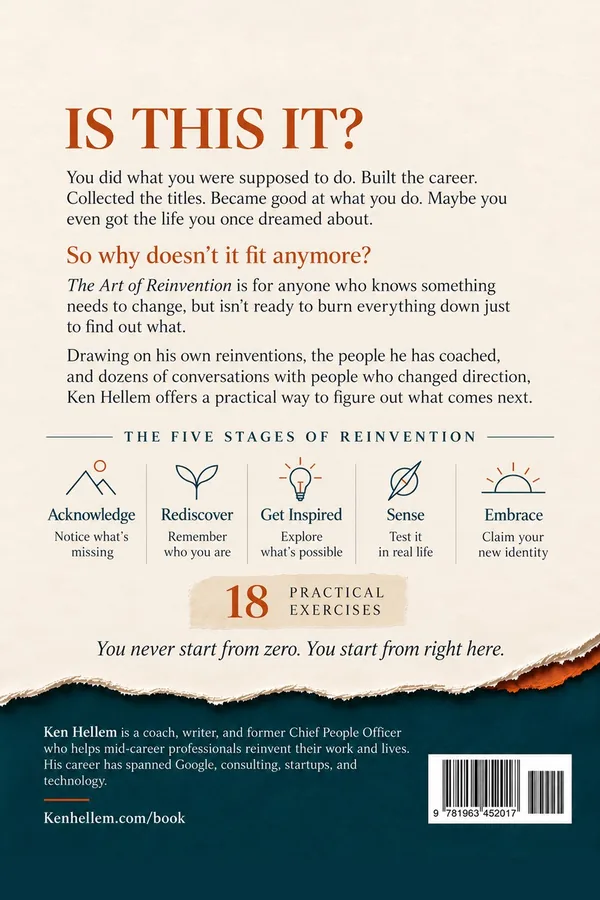 Hover for the back. Click for the book.Tap to see the book
If you want the full process, from the first feeling that something is off to making the change, the book is here.
Questions people often ask
How long should I test a new career before quitting my job?
A month is a good starting point. It's long enough to see both the good days and the bad days, and short enough to fit around your job and family. Give the test a clear start and end date. Many people already know after two weeks whether the work is for them.
Can I try a new career while working full time?
Yes, and that's the best way to do it. Run a small test on evenings and weekends, while your job keeps paying the bills. If you don't have a month of free evenings, go smaller: one Saturday or a few lunch breaks. The size matters much less than actually doing it.
What should I track when testing a new career?
Track two things: what happens inside you, and how people react. Each day, write down what you did, your energy from 1 to 10 and your mood. Note what gave you energy, what drained you and when you lost track of time. Then note what people commented on, asked about or bought.
What if my career test shows the new path isn't for me?
Then the test worked. You found out in a month, alongside your job, instead of after quitting. Moving on is one of four useful answers, together with continue, adapt and redirect. Often you'll find that part of the idea fits and part doesn't, so you adapt and test again.