
I've always told myself that I'm not a dancer. So I never tried. Instead I stand awkwardly in the corner while the people who "naturally dance" have all the fun.
I don't know where this belief came from. I DJ and play guitar, so I know I have rhythm. Maybe someone made fun of my dancing when I was a kid, and it just became my truth.
Most of us carry a story like that about our careers. "I'm not creative." "I'm too old to start over." So how do you challenge limiting beliefs about changing your career? Start with one simple question: is it really true? Write the belief down, separate the facts from the stories, and then look at the actual evidence for and against it. Most career beliefs have much weaker evidence than you think.
Where do limiting beliefs about your career come from?
Many of them started out as useful. Being the responsible one might be part of the reason people trusted you. Being prepared might have made you great at your job. Keeping your creative side hidden may have protected you from being judged. By people who don't matter.
The problem starts when a useful belief quietly turns into a rule.
"I am responsible" becomes "I can't take risks." "I support my family" becomes "I can't change careers."
At some point, the rule that helped build your old life can become the same rule preventing you from building the new one.
From The Art of Reinvention
So when you look at your own beliefs, ask two things. Where did this come from? And how long have you believed it?
Why does a limiting belief feel like a fact?
Aaron Beck, one of the founders of cognitive behavioral therapy (CBT), noticed something while studying depression in the 1960s. His patients had a constant stream of what he called "automatic thoughts." Underneath those thoughts were deeper beliefs and assumptions about themselves, other people and the world.
What I find most useful here is this. Those deeper beliefs don't feel like beliefs. They feel like facts.
After years of believing you are not creative, or that people like you don't start businesses, you stop checking the evidence. You just live that way. And because the belief shapes how you see what happens, you may even ignore evidence that goes against it.
A few decades later, Byron Katie built a whole self-inquiry method around almost the same idea. In her book Loving What Is, you write down a stressful thought and start with two very simple questions: "Is it true?" And then: "Can you absolutely know that it's true?"
I found her work while researching a chapter I had already named "Is It Really True?" So I wasn't quite as original as I thought. Bummer.
But I love how simple the question is. Before you try to overcome a belief, replace it, or manifest your way around it, just ask: is it actually true?
How do you tell a fact from a story?
Back to my dancing. I have believed for decades that I can't dance. But I have done almost no research into the matter. I have never taken dance lessons. I have never seriously practiced. I have never asked an independent panel of judges to assess my hips... And we all know, hips don't lie.
The evidence for my belief is surprisingly weak. And yet, in my head, that case has been closed for years.
Your career beliefs might be the same. But I'm not asking you to shout positive affirmations at yourself. Some beliefs contain real facts, and those facts matter. The trick is to separate the fact from what you have added on top of it.
- You might be forty-eight years old. That's a fact. "Forty-eight is too old to change careers" is a story.
- You may never have been paid for this kind of work before. Fact. "Nobody will ever pay me for it" is a prediction.
- You might have a mortgage, children and six months of savings. Those are real facts, and you need to plan for them. "Therefore I have to stay in this career for another twenty years" is a conclusion.
There is a difference. Facts you plan around. Stories, predictions and conclusions you test.
Here are some of the most common limiting beliefs about changing careers. See if one of them sounds familiar.
- You're too old to start over.
- You don't have the right qualifications.
- Nobody will hire you without direct experience.
- You're not creative enough.
- You're too introverted to build a business.
- You can't call yourself a writer until somebody publishes you.
How to challenge limiting beliefs about changing your career: the courtroom exercise
When I thought about how to challenge these beliefs, a courtroom seemed like the obvious picture. Put the belief on trial. Hear both sides. Look at the evidence. Reach a verdict.
Again, I wasn't as original as I thought. The Brazilian psychiatrist Irismar Reis de Oliveira developed a cognitive therapy technique using almost exactly this idea. His version is designed for therapy and is much more detailed. The principle is simple: instead of accepting a deep belief automatically, you investigate it. There is a prosecution, a defense and a verdict based on the evidence.
Here is the simpler version from the book.
- Pick the belief. Take the list above and add your own. Circle the one most likely to stop you from moving forward. Write it at the top of a page exactly as it sounds in your head.
- Divide the page in half.
- Make the case for the belief. On the left, list the actual evidence that says it is true.
- Make the case against it. On the right, list the evidence from your life, your conversations and your experiments that says it may not be as true as you thought.
- Call witnesses if you need them. Talk to people on both sides. Cross out the weak arguments. Underline the strong ones.
- Give your verdict. You are the judge. What is actually true, and what is made up?
There are three possible verdicts. The belief is complete nonsense, and you can finally let it go. Or there is some truth in it, but you have exaggerated what it means. Or it points to a real obstacle that you now need to deal with. All three are useful answers.
My own limiting belief: I shouldn't charge for what I love
Dancing can wait for a future reinvention. Who knows? But in my last reinvention I had a belief that mattered a lot more.
I believed I shouldn't charge for things I find valuable. If something came naturally to me and helped another person, giving it away felt generous. Charging for it felt wrong. Not a great belief for somebody trying to make a living.
A friend gave me a reframe that helped. You need to pay your bills. So you have two choices. One, get a job doing something you don't particularly love, and spend your free time doing what you love for free. Or two, learn to charge for what you love, and spend much more of your life doing it.
The choice became easy. It got things moving. But I'm still working on it.
That's the annoying thing about limiting beliefs. They rarely disappear because somebody says a clever sentence. I still needed to collect evidence.
And here's the good news. You don't have to fully believe the new story before you start acting on it. Sometimes the action is what finally gives you the evidence you need.
That is why the book keeps pushing you out into the real world. Conversations with people who have done what you want to do give you their experience. That is the idea behind doing your own 50 Lunches. Small experiments let you try a possibility instead of guessing what it would feel like. That is the Dress Rehearsal, and there is more about it in how to try a new career before you quit.
Each conversation and each experiment is a piece of evidence. Bring them into your courtroom. One old, untested story should not overrule everything you have learned about who you are, what you want and what might fit. If you want a starting point for that last part, the True Self Archetypes quiz is a good place to begin.
Where this comes from in the book
This post is based on the chapter "Is It Really True?" from the Embrace part of The Art of Reinvention. Embrace is about acting on your new direction, stepping outside your comfort zone and taking on your new identity. The courtroom exercise is in there, together with the next hard question: how to make the numbers work.
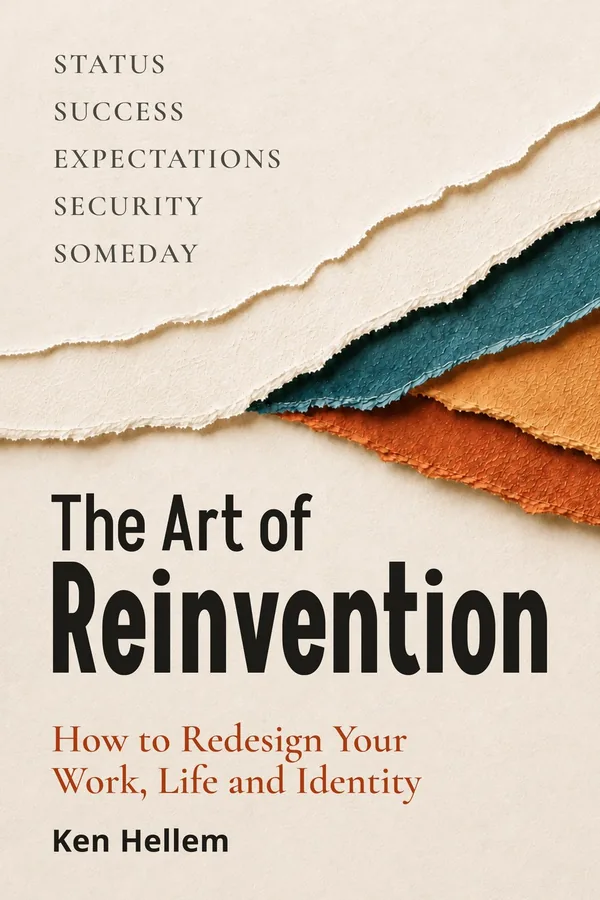
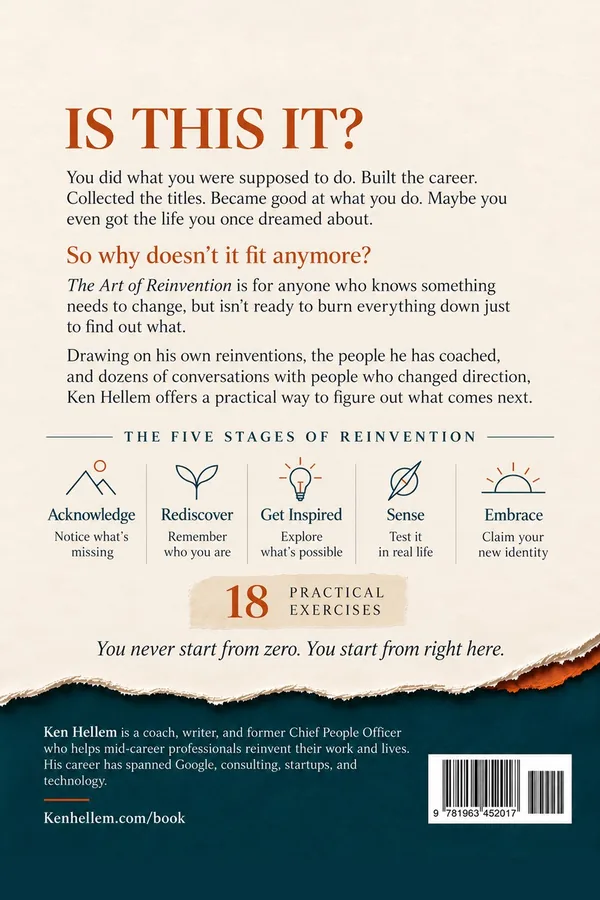 Hover for the back. Click for the book.Tap to see the book
If an old story has been making your career decisions for you, the book walks you through what to do about it.
Questions people often ask
What is a limiting belief about your career?
It is a story about yourself that you treat as a fact, like "I'm not creative" or "I'm too old to start over". Many started as useful, like being the responsible one. The problem starts when a useful belief turns into a rule, like "I can't take risks".
Am I too old to change careers?
Your age is a fact. "Too old to change careers" is a story you have added to that fact. Write down the real evidence for and against it, and talk to people who changed careers at your age. Then decide based on the evidence, not the story.
How do I know if a limiting belief is true?
Put it on trial. Write the belief at the top of a page, list the evidence for it on the left and against it on the right, and cross out the weak arguments. Then give your verdict. It might be nonsense, it might be exaggerated, or it might point to a real obstacle you need to deal with.
Do I have to believe in myself before I make a career change?
No. You don't have to fully believe the new story before you start acting on it. Small experiments and conversations give you real evidence. Often the action is what finally changes the belief.