Most people can feel that something is wrong at work long before they can say what it is. The job looks fine on paper. You might even be good at it. But if someone asks what exactly is wrong, you don't have an answer.
I lived like that for years. I kept guessing what the problem was. More money. A new country. A bigger goal. I got most of them, and none of them solved the real problem.
So if you are asking yourself why am I unhappy at work when I can't say why, here is the short answer. You are probably describing the problem with a word that is too big, like "career" or "purpose". The real problem sits one level below that word. You find it by defining the word in your own terms, describing what a great version would look like, and writing down exactly what is missing today.
Why am I unhappy at work when I can't say why?
Because the words we use for our lives are big and general. Purpose, finances, health, relationships, career. They are a good starting point. But each one hides a more specific truth.
Take relationships. For one person it means feeling lonely, without a good circle of friends. For another it means looking for a life partner. For a third it means not being able to connect deeply with the people already in their life. Same word. Different meaning. And each one needs a very different solution.
Health works the same way. Are we talking about physical health or mental health? A specific diet? Looking good for the next beach season, or still being able to use your body when you get old? Different people mean very different things.
Work is no different. "I'm unhappy at work" could mean the tasks bore you. It could mean the hours, the team, the manager or the industry. It could mean you have no say over your own day. Until you know which one it is, every fix is a guess. And a guess can cost you years.
Looking back, a lot of my guesses were trying to fix the wrong problem. I hadn't found the right words yet.
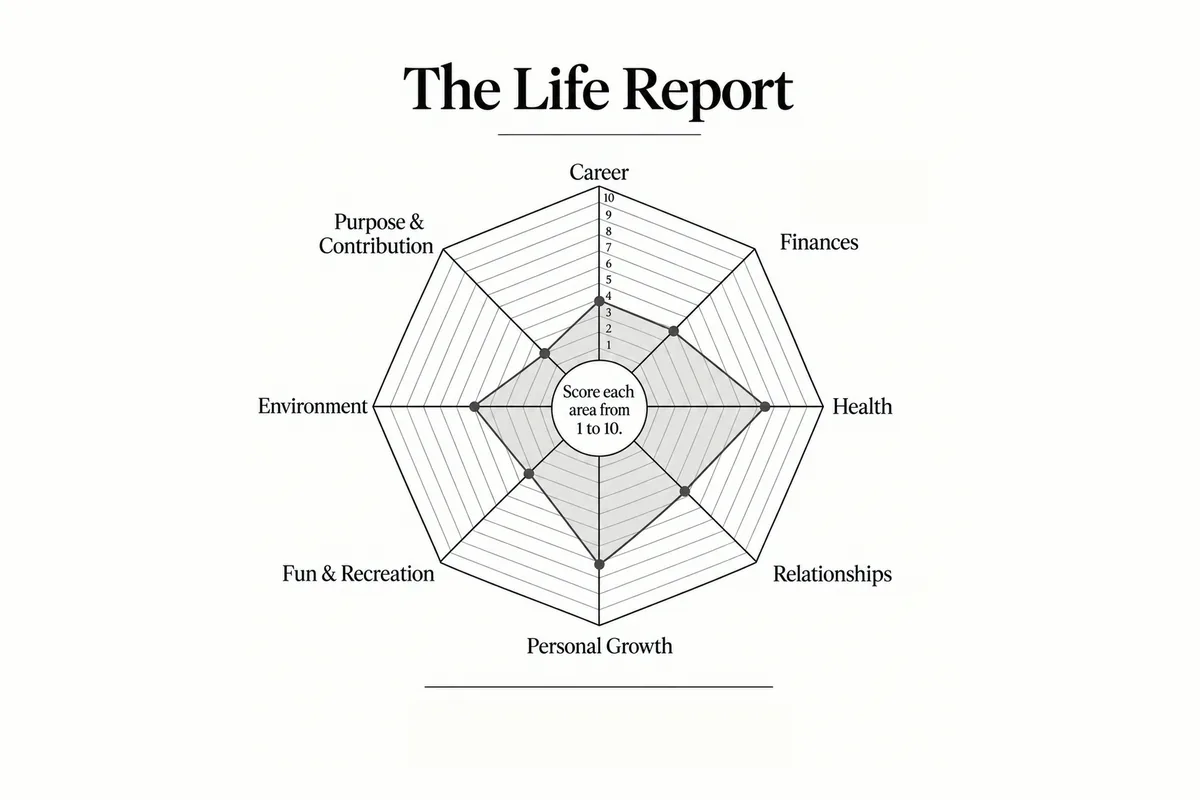
A good first step is the Life Report, a 4-minute self-assessment. It scores the main areas of your life and shows you approximately where the problem is. But a score is only a starting point. The next step is to find the words behind it.
Can you be unhappy in a career that looks successful?
Yes. In the book I write about Mark. He spent decades at the same firm. By any outside measure, most people would call it a successful career.
If you had asked Mark to score his career, he might have said a seven. Maybe an eight. Nothing was obviously wrong with it. The number would have looked fine on paper, the same way his life looked fine from the outside.
But Mark's real gap was deeper than the job. It sat in an area the Life Report doesn't have a slice for. Something closer to freedom, or autonomy. Somewhere along the way he had stopped choosing his life. He had accepted whatever life handed him, and forgot that another life was possible. The longer that went unnoticed, the more normal it felt.
A high score on Career can hide a much lower score on whether or not this was the career you wanted in the first place.
From The Art of Reinvention
So a decent score does not prove that you are fine. If your career scores well and you still feel flat, ask a second question. Did you choose this career, or did you just keep going?
Is it your whole career, or only one part of it?
When something feels wrong, it is tempting to make the problem bigger than it is. A bad year becomes proof of a bad career. Exhaustion becomes proof that you chose the wrong path. A difficult company becomes a reason to imagine a completely different life.
Sometimes those conclusions are correct. But not always.
Before you decide what comes next, separate the parts of your work that no longer fit from the parts that still do. Maybe you still like the work but want more autonomy. Maybe you like the industry but no longer want to lead a large team. Maybe you still enjoy your profession, but the culture or the pace no longer works for you.
And sometimes the real problem is how much of your life your career takes up.
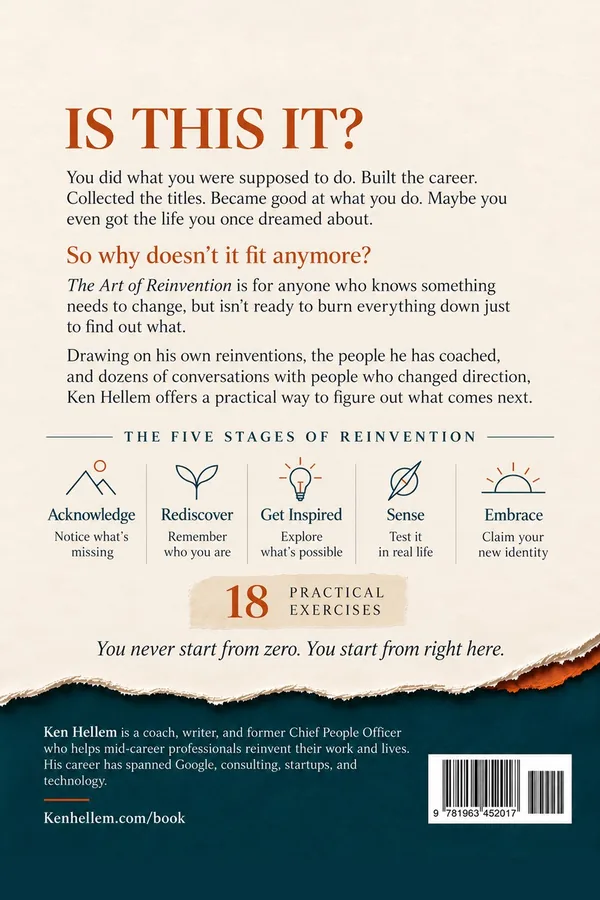
In the book I describe four types of reinvention. Two of them show why this matters. A Career Redesign keeps the career and changes the details. A Full Reinvention accepts that the old life no longer fits and makes a real break from it. Both can start from exactly the same feeling. But they need very different amounts of change. If you are not sure which one you are facing, the Reinvention Type quiz takes 10 questions.
So get specific. The size of the change should match the size of the problem.
Exercise: define your gap in six steps
This is the exercise from the chapter. You need a notebook and some quiet time. Start with your lowest-scoring area from the Life Report. Let's say it's relationships, and you scored it a three.
- Define the word yourself. Don't look it up. What does "relationships" mean to you? What's included, and what's not? Friends, family, a partner? Why is it important to you?
- Describe a ten. What would have to be true for you to score it a ten? A big group of friends, or a few deep relationships? Write down what perfect would look like. You don't have to aim for a ten. You are only defining the scale.
- Describe your three. A three means something already exists. What are you happy with? What's missing? How does it feel to be a three? Lonely? Frustrated? If you want to change your score while you write, go ahead. It's your score.
- Set a target you can reach. Not a ten. Not even an eight. Pick a score you think you can reach in the next six to twelve months. Weigh the effort against the benefit. If it feels too difficult, drop it one point.
- Describe the target in detail. Spend five minutes writing what that score looks like. Be specific. For example: "Every week I spend quality time with my kids." Or: "I have gone on at least three dates."
- Repeat for your other low scores. Then read everything you wrote.
The good news is in step four. Your lowest areas are the ones where a small change counts the most. Moving one of them up just a point or two can make a big difference to your overall happiness.
If your lowest score is career, do exactly the same thing. Write your own definition of a good career. Describe a ten. Describe where you are now. Then write down the one or two changes that would move you up a point this year.
When you finish, you will have gone from "I'm not happy with my life" to knowing exactly what that means. Clarity! Doesn't that feel good?
Write down what you want to keep, too
There is one more step before you close the notebook. It's easy to list what you want to escape. It's harder, and just as useful, to name what you would fight to hold on to.
The Life Report shows your gaps. It also shows where your life is already good. Write those things down. Maybe you love your colleagues. Maybe your job gives you time with your family. Maybe you are proud of your skills.
This list protects you from throwing away the good parts together with the bad ones. It also tells you what any new plan has to include.
Where this comes from in the book
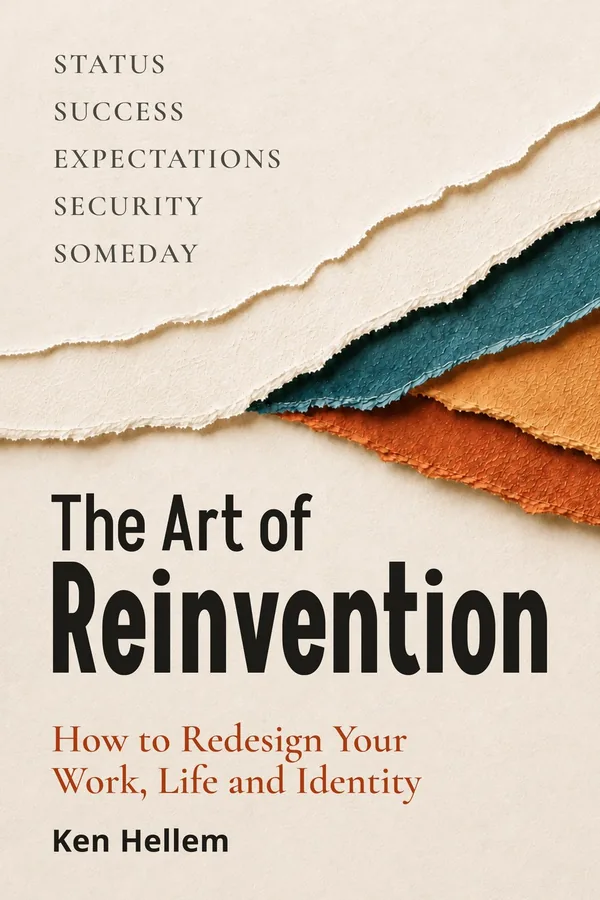
This post is based on the chapter "Let's Get Specific" from the Acknowledge part of The Art of Reinvention. In the book it follows the Life Report, and it leads into the harder step. Writing it down is the first step. Admitting it, really admitting it, is what makes it real.
 Hover for the back. Click for the book.Tap to see the book
You can find this exercise and the other 17 from the book on the book tools page. And if you want the whole process, from the first feeling to a new life that fits, here is the book.
Questions people often ask
Why am I unhappy at work when nothing is obviously wrong?
Usually because the problem hides behind a big word like "career" or "purpose". Your job can score a seven and still not be the career you would have chosen. Write your own definition of a good career, describe what a ten would look like, and compare it with today. The gap you find is the real problem.
How do I figure out what exactly I want to change about my job?
Separate the parts that no longer fit from the parts that still do. Maybe you like the work but want more autonomy, or like the industry but not leading a big team. Write both lists. The more precise you are, the easier it is to pick the right change.
Should I quit my job if I'm unhappy at work?
Not automatically. A bad year or a difficult company can feel like proof that your whole career is wrong, and sometimes it isn't. First find out how big the problem really is. The size of the change should match the size of the problem.
Do I need to aim for a perfect ten in every area of my life?
No. Describing a ten only defines the scale. Set a target you can reach in six to twelve months, often just one or two points higher. In your lowest areas, a small move can make a big difference to how happy you feel overall.