
Most people think reinvention starts at rock bottom. A firing. A divorce. A diagnosis. Those can be triggers. But most reinventions start from a position of success.
You are doing well. On paper, your life is good. You have a great job, or you're building your own business. You have people who love you. You reached some big goals. And still, a small voice in the back of your head keeps asking the same question. Is this it? I thought there would be more.
If you feel "is this it?" about your life or career in your 40s, it usually means your life no longer fits the person you have become, even though nothing is broken. It is a signal to stop and look at which part of your life feels off. It does not mean you have to quit or start over.
Why do I feel "is this it?" when my life looks good?
Because nothing looks wrong. For many people this shows up in their forties, after the big goals from their twenties and thirties are done. Every day looks mostly like the day before. There is nothing you can point at and call broken. So you tell yourself to be grateful and keep going.
Take Mark, from my book. He spent close to three decades at one of the most respected firms in his industry. He climbed the ladder across several continents and ended up managing a large investment portfolio. By every outside measure, it was the dream job. He said so himself, more than once.
So I asked him why he wanted to change. He asked me if I had ever seen the movie The Shawshank Redemption. "This had been my reality for so long," he said, "I had gotten so used to living in it, that I didn't even realize the walls around me had become a prison."
That is the "is this it?" feeling. A good life that has become so normal you forget another life is possible. Mark did get out in the end. Last I heard, he was starting his own firm. Same industry, same skills, same network. But this time it was his.
I didn't notice it myself until I got fired
I was let go from my Head of Product role. And I was surprised. I had been telling myself, and everyone else, a story of success. I wanted so much to be a successful entrepreneur, the next Steve Jobs, that I had convinced myself this was it.
It took getting fired for me to admit that the passion had died a while ago. What I actually liked was building the team and thinking about coaching frameworks. Not customer research. And definitely not prioritizing bugs and feature requests, day after day. Turns out I was probably never meant to be a product manager in the first place.
I'm sure I would have got there on my own eventually. Getting fired just sped it up. Not everyone is that lucky.
This is also why a firing on its own does not tell you that you need to reinvent. If you were happy in your old job, you can look for a similar one. The important question is whether you were happy. And whether you could even tell the difference. If work is the part that feels off, why am I unhappy at work goes deeper.
How to hear the question when your life is busy
The problem is that we often don't hear the question at all. We are too busy. The never-ending to-do list. The next big deliverable. Family. Social plans. Getting enough exercise. We fill our calendars so full that we rarely have time to just be.
That's why the big realizations tend to happen away from routine. In one survey of two thousand UK holidaymakers, four in ten said they had made a life-changing decision while away. More than a quarter of those decisions were a career switch. That matches what I see. People figure things out when they travel, or when they take time off. No one has ever told me they figured it out while running between meetings or checking their Slack messages. If you're thinking about longer time off, read my post on micro-retirements and career breaks.
The smartest people I know put real time aside to think about their work instead of doing it. One founder I worked for kept his Mondays free for exactly that. I suggest doing the same with your life. You probably can't take every Monday off. These smaller habits work too:
- A walk without your phone. Our minds are so used to distraction that being alone with our thoughts feels uncomfortable. I challenged the team at Ultimate Beauty to go for daily walks without their phones. Many found it hard. Several people reported feeling anxious, and some refused to try. There is even a word for it: nomophobia, short for "no mobile phone phobia." Your mind needs a while without input before it starts making new connections. So walk in silence for thirty minutes. If that's not realistic, do ten. The silence matters more than the length.
- Meditation. The practice is really about teaching your mind to be calm. For me, insights don't usually show up during the meditation. They show up later in the day, because my mind is already calm. When I remember to meditate, that is. I tend to forget when I'm stressed.
- Journaling. I keep a daily journal of my thoughts, ideas and feelings. I also have weekly, monthly, quarterly and yearly rituals where I step out of the day-to-day and look at the bigger picture.
A five-minute exercise to see what feels off: the Life Report
Every end of year, I spend a couple of hours redoing my Life Report. It's my version of a classic coaching exercise known as the Wheel of Life. You score the main areas of your life, and the scores show you where you feel strong and where you feel thin. Here is how to do it on paper:
- Take a piece of paper and give it five minutes at most. Don't aim for perfection. Trust your gut.
- Score eight areas from one to ten: Career, Finances, Health, Relationships, Personal Growth, Fun & Recreation, Environment, and Purpose & Contribution. A one means this part of your life is empty or painful. A ten means it could not be better. Swap in your own categories if some don't fit.
- Write every score down, even the obvious ones. Seeing it on paper makes it real in a way that thinking never does.
- Spread out the clusters. If you have a lot of fives or a lot of sevens, rank those from lowest to highest and nudge them a little up or down.
- Draw the chart. Draw a circle and cut it into eight slices, like a pie. Write one category at each line. The center is a one and the rim is a ten. Mark each score, then connect the marks.
- Circle your two highest and two lowest areas. Celebrate the strong ones. They give you energy to keep moving. The low ones are where you look next.
If you'd rather not draw, the online Life Report takes about four minutes and draws the chart for you.
Most people draw something lopsided. Full and round on one side, caved in on the other. That dented shape is not a failure. It's data. It shows you where your life is right now.
Why "fine" is the real problem
In the responses to my own Life Report, the most common score people give is a five. That's not a big study. But Gallup finds the same thing on a much bigger scale. Every year they ask people all over the world to rate their life from zero to ten. Only about a third rate it high enough to count as thriving. Most of the rest sit in the middle, which Gallup calls struggling.
Most people are not sitting in crisis mode, but they are not thriving either. They are fine. And fine is a strange place to be. It is comfortable enough to not have to act. But at the same time painful enough to quietly bother you.
From The Art of Reinvention
The good news is that most of the planet is right there with you. The bad news... do you really want to spend the next twenty years of your life being just "fine"?
Once you see which areas are low, the next question is how much needs to change. Maybe a lot. Maybe very little. My post on the four types of reinvention helps you figure out which kind of change fits.
Where this comes from in the book
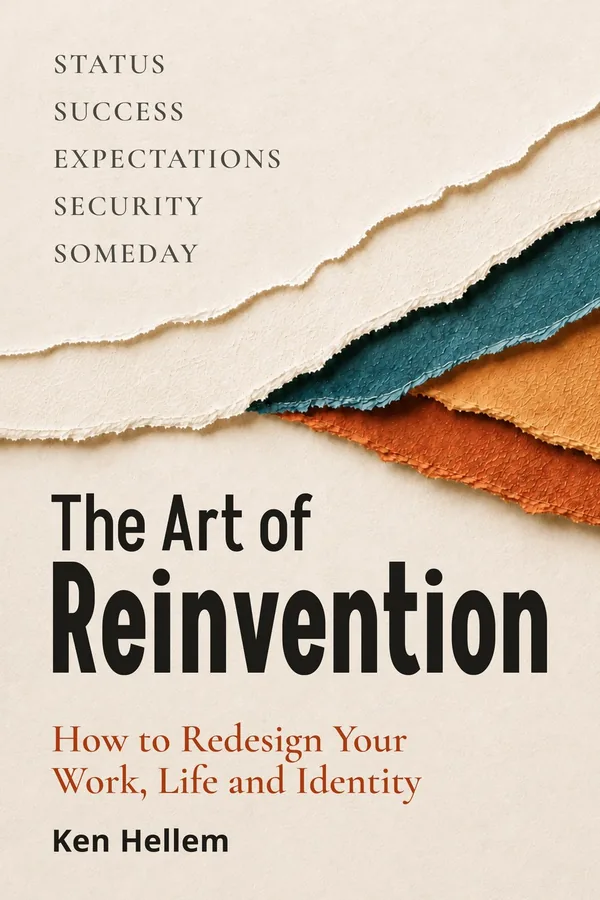
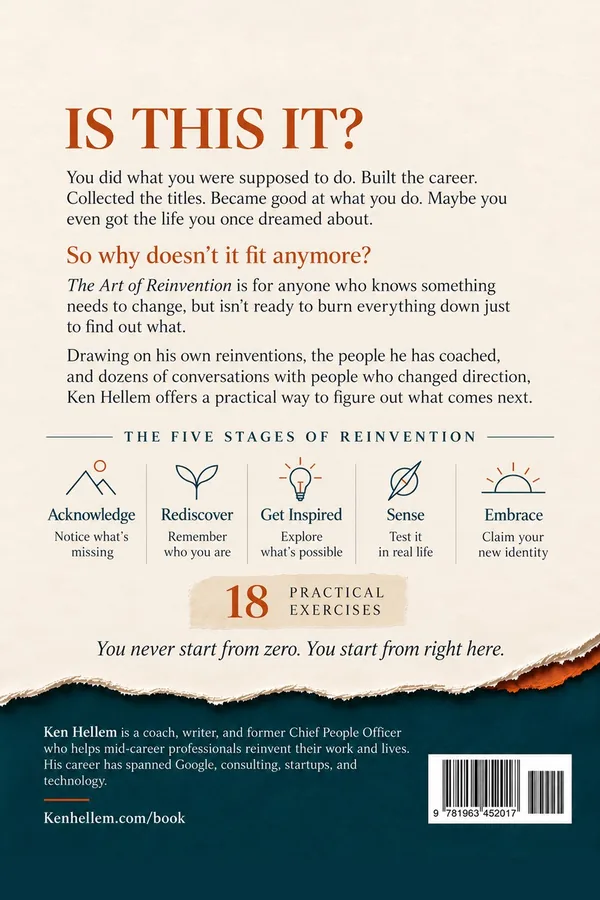 Hover for the back. Click for the book.Tap to see the book
This post comes from the chapter "Is This It?" in The Art of Reinvention. It opens Acknowledge, the first step of the ARISE method, where you notice and admit what is really going on before you decide anything. The chapter ends where the next one starts: a low score almost never means what it says on the label. If you want to find out what yours means, the book is here.
Questions people often ask
Is it normal to feel "is this it?" when my life is good?
Yes. Most reinventions start from a position of success, not from a crisis. You can have a good job, people who love you and big goals behind you, and still feel something is missing. Gallup finds that only about a third of people rate their life high enough to count as thriving, so you are far from alone.
Why do I feel "is this it?" in my 40s?
By your forties, many of the big goals you set earlier are done, and each day looks a lot like the one before. Nothing is broken, so it is hard to point at the problem. The feeling is often a sign that you have changed while your life stayed the same. It is worth looking at, not ignoring.
Does feeling "is this it?" mean I need to quit my job?
No. It means something feels off, and the first step is to find out what. Score the main areas of your life, for example with the Life Report, and see which ones are low. Sometimes the answer is a new career, sometimes it is a small change to your role or to the life around your work.
How do I figure out what is missing in my life?
Make time away from your routine, even a thirty-minute walk without your phone. Then score eight areas of your life from one to ten: career, finances, health, relationships, personal growth, fun, environment and purpose. Your two lowest scores show you where to look first.