When work stops fitting, most people think there are two choices. Stay and put up with it. Or quit the job, sell the house and start over somewhere new.
I know the appeal of the second one. I've done it. But most people cannot, and probably should not, blow up their lives every time something stops fitting.
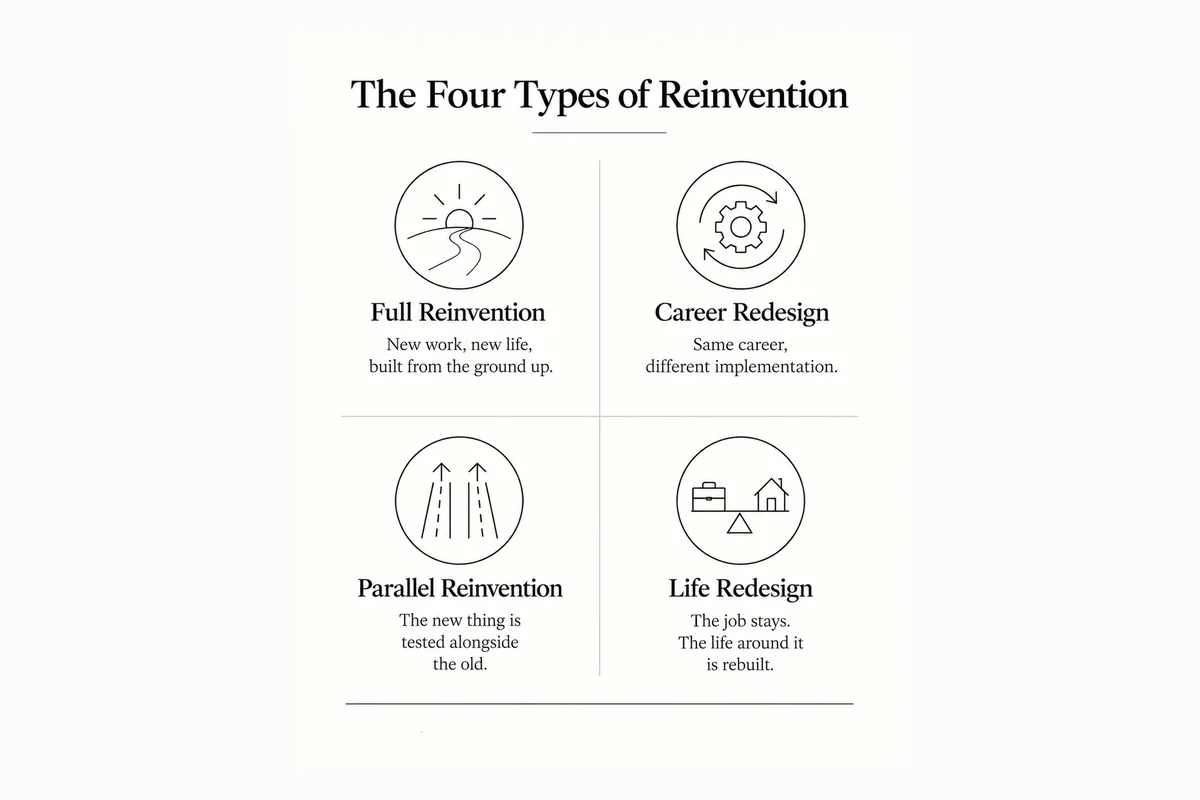
So what type of reinvention do you need? There are four types. A Full Reinvention is a new career. A Career Redesign keeps your field but changes your role. A Parallel Reinvention builds something new next to your job. A Life Redesign keeps your work and changes the life around it. Many people who think they need a new career only need to change one part. And some need no reinvention at all.
If you want a quick answer, take the Reinvention Type quiz. It asks ten simple questions and tells you which type fits your situation right now. It takes less than five minutes. Below I explain each type, so you can check the result against your own life.
Do I need a new career or just a new job?
This is usually the real question. You know something has changed. You don't know how much of your life needs to change with it.
Start by naming what changed. Maybe you changed, and you outgrew your role. Maybe the company changed. New leadership. New policies. No more unlimited expense accounts. Maybe your whole field is shrinking. Each of these calls for a different size of change.
1. Full Reinvention: a new career
This is the big one. You decide the old life no longer fits, and you make a real break from it. For me, that was starting over in New York.
A full reinvention might mean leaving a career you spent twenty years building. Moving to a new country. Going back to school. Starting a company. Entering a completely different field. Sometimes you choose the break. Sometimes it is made for you.
Imagine someone who has worked for twenty years in a field that is being automated. She loses her job and looks for the same job somewhere else. She finds fewer roles, lower salaries, and no reason to think the trend will change. She has to reinvent.
This type costs the most. You may have to learn new skills and become a beginner again. You may also lose status, expertise, community, income and an identity that took decades to build. If that part hits you, I wrote about it in who am I without my job title.
But starting again does not mean starting with nothing. You bring judgment, relationships, experience and skills. You also know yourself much better than when you chose your first career.
2. Career Redesign: same field, different job
A career redesign is a smaller change. You're no longer happy, but only part of the career is the problem. You keep what still fits and change what doesn't.
Some examples. A senior leader still loves helping people grow, but now spends more and more time on budgets, politics and admin. A doctor still cares about medicine, but no longer wants the never-ending hours in hospital halls. A software engineer who loves coding gets promoted, and now spends the day managing a team instead.
I did this at Google. For two years I led the team supporting our customer relationship with Spotify, one of our largest customers. Then the head of startups role opened up, and I switched. I went from supporting Sweden's largest startup to supporting hundreds of the smallest ones. Same skill set. Very different job.
From the outside, a career redesign can look small. For the person making it, it can be night and day. If your question is "new career or just a new job?", this is often the answer.
3. Parallel Reinvention: build the new thing next to the old one
The third type is also known as the side hustle. You build the new life next to the old one.
Instead of asking "Do I stay or do I leave?", you let two things exist at the same time. You keep your day job and start coaching. You stay an accountant and develop your photography (pun intended). You work four days a week and spend the fifth building something of your own.
This works well if you think your industry is changing but the threat is not immediate. You can create options before you are forced to.
It is what I should have done at my last job. Build something new while ramping down the old. It would have been the sensible choice. But I've never been great at split focus. When I try to do two things at the same time, I end up doing both poorly. Many people pull it off anyway.
The new part can start tiny. It may not earn money. You may not know if you want it to become your main work. That is why this type is useful. You find out if you enjoy the work, if other people value it, and how the new identity feels, before you bet everything on it. I go deeper into this in how to try a new career before you quit.
Over time the side project may become the main thing. Or you may find that you like having both. There is no rule that the new thing has to replace the old one.
4. Life Redesign: keep the job, change the life around it
The fourth type is the least obvious, because your career may barely change. Sometimes what needs to change is the life you have built around your job. This is what happened to my best friend Johan, and his story is in the book.
Many of us expect work to solve all our problems. The job becomes our identity. It becomes our source of status, growth, creativity, community and meaning. We forget we have a life outside work. Or worse, work becomes the escape.
Then we stop taking care of our relationships, our health and our interests. When something goes wrong, we blame the job. We decide we chose the wrong career. But maybe the job has simply become too large.
A life redesign might mean the same profession with fewer hours. It might mean more time for relationships, health, creativity, travel or community. Or you stop chasing the next promotion, because you no longer need your career to prove that you have value.
This matters more when jobs are less stable. If your whole identity is tied to one employer or one title, losing it takes everything with it. A fuller life outside work makes change easier to absorb when it comes.
Living a sturdier life might look like nothing from the outside. But from the inside, it's a whole different ballgame. Instead of organizing your life around your work, you start organizing your work around your life.
From The Art of Reinvention
How do I know what type of reinvention I need?
Start with the quiz. The Reinvention Type quiz is built from this chapter of my book. Ten simple questions, less than five minutes, and it tells you which of the four types best matches your situation right now.
It can also tell you that you don't need one. You might find that your life is mostly right as it is. Your career might not need to change at all. That is a real answer too.
Four things to keep in mind when you take it:
- Be honest with yourself. It's a simple quiz, and it's easy to trick, on purpose or without noticing. Your result is only as good as your answers.
- Treat the result as a starting point. If it tells you to sell your home and move to another country, take that with a grain of salt. Do a few more exercises before you act on it.
- Expect the types to mix. They are not boxes. You might start with a Life Redesign and find that the career itself is the problem. A Parallel Reinvention might grow until a Full Reinvention is the obvious next step. A layoff might lead to a Career Redesign, and six months later you realize you don't want to rebuild the career you lost.
- Ask the better question. Don't ask whether you should blow it all up. Ask: "Given what has changed, in me and around me, what kind of reinvention does my life actually require?"
If you're not sure yet what has changed, start there. My post on the "is this it?" feeling is a good first step.
Which type of reinvention is the best one?
None of them. The four types do not rank people. Leaping is not braver than staying.
What matters is whether you choose. Some people live by default and let the years pass. Others look at a life that no longer fits and change it on purpose. You can do that with any of the four types. Even with the smallest one.
The four types in The Art of Reinvention
 Hover for the back. Click for the book.Tap to see the book
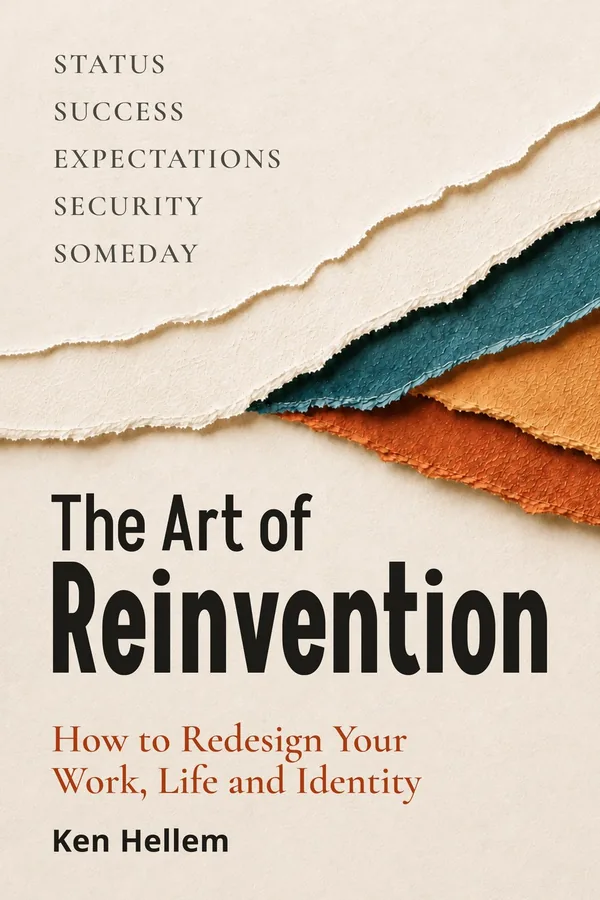
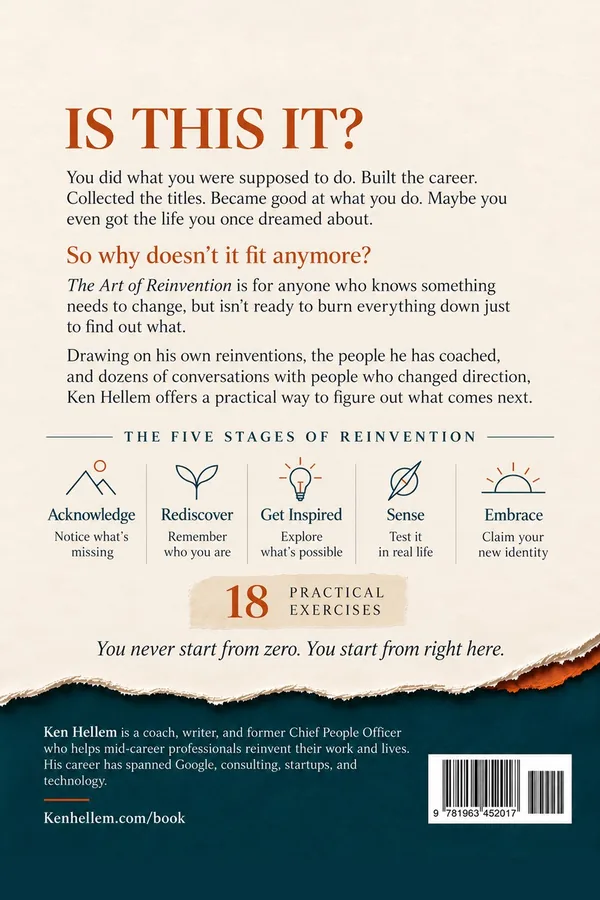
The four types come from the introduction of my book, The Art of Reinvention. The quiz is the first exercise. The rest of the book helps you figure out what has changed for you and what to do about it, one step at a time. If you want to go further than the quiz, you can find the book here.
Questions people often ask
What are the four types of reinvention?
The four types are Full Reinvention, Career Redesign, Parallel Reinvention and Life Redesign. A Full Reinvention is a real break into a new career or life. A Career Redesign changes the parts of your current career that no longer fit. A Parallel Reinvention builds something new next to your job, and a Life Redesign keeps your work and changes the life around it.
Do I need a new career or just a new job?
Start by naming what changed. If you still like your field but not your role, your company or your daily tasks, you probably need a Career Redesign, not a new career. If the whole field no longer fits you, or it is disappearing, a Full Reinvention may be the answer. The Reinvention Type quiz on my website helps you check.
Can I reinvent my career without quitting my job?
Yes. A Parallel Reinvention lets you build something new next to your job, for example coaching or photography on the side, or one day a week for your own project. You find out if you enjoy it and if people value it before you give up your salary. A Life Redesign also keeps the job and changes what is around it.
What if I don't need a reinvention at all?
That is a real answer. Some people find that their life is mostly right as it is, and their career might not need to change at all. The Reinvention Type quiz can give you that result too. Knowing it is useful, because it stops you from making a big change you don't need.